
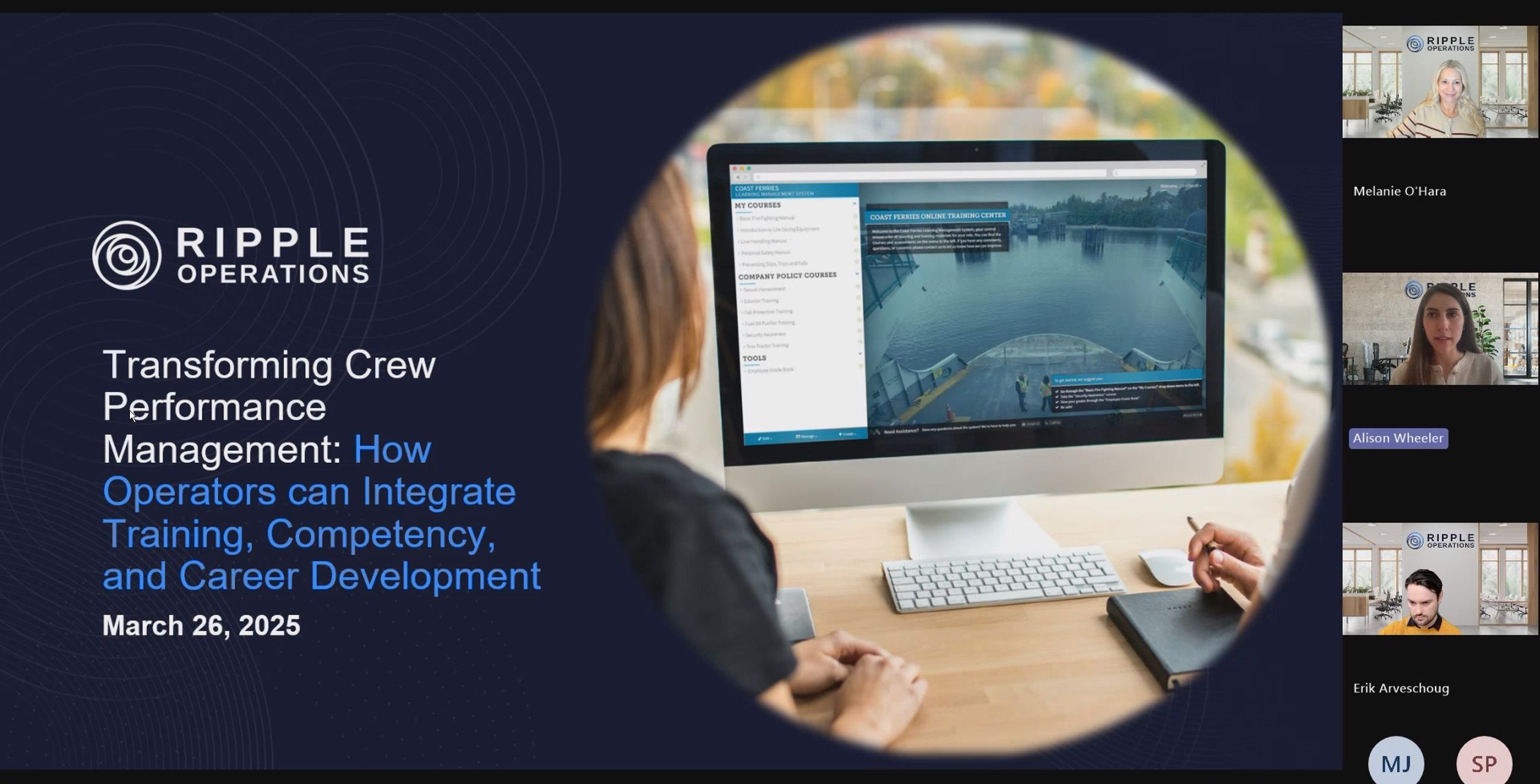
Webinar Recap and Key Takeaways
How many systems does it take to manage crew training, certifications, and performance across your fleet?
It’s a simple question, but for many maritime operators, the answer is anything but so.
In our recent webinar with Senior Account Director Melanie O'Hara and Account Manager Erik Arveschoug, we started there. Not with technology, but with the reality operators face every day: paper-based processes that haven’t fully disappeared, spreadsheets that have taken on a life of their own, and multiple systems that don’t quite connect.
The result is a fragmented picture of crew readiness and development. Training records live in one place, evaluations in another, and competency evidence is often incomplete or difficult to verify. Managers and shore-side staff are left piecing together information, trying to answer a deceptively basic question: Is our crew truly ready?
Too often, the answer comes late: after an inspection, or worse, after an incident.
Moving Beyond Administration
Moving Beyond Administration
One of the central ideas we explored in the session is that without integration, performance management remains administrative. Teams spend their time managing processes instead of improving outcomes.
What operators are really looking for isn’t just a better way to track training. It’s a way to connect training, assessment, performance, and development into a single, continuous system.
That’s the thinking behind the Ripple Performance Management: Train, Assess, Evaluate, Develop, Advance. Not as separate components managed in different tools, but as a connected system where information flows naturally between each other.
When those connections exist, something shifts. Training stops being a checklist. Evaluations become more meaningful. And decisions about deployment and progression can be based on real evidence, not assumptions.
What It Looks Like in Practice
What It Looks Like in Practice
During the webinar, we showed this concept in action through a series of short product demonstrations.
We started with the Ripple Learning Management System, since it’s where most of the day-to-day crew development activity happens. But the focus wasn’t just on delivering content. It was on removing the manual administrative work that surrounds it. Instead of enrolling crew one by one and following up on completion, the system automatically assigns the right training based on a crew member’s role and vessel. Progress updates flow back without anyone needing to send an email or update a spreadsheet.
One of the biggest questions we hear from operators came up here as well: does it actually work at sea? In the demo, we showed how training can be accessed fully offline onboard, with synchronization designed for low-bandwidth environments. The experience for the crew remains seamless, while shore teams maintain visibility on training progress and records automatically.
From there, we shifted to something that’s much harder to capture with traditional systems: practical skill.
In most organizations, skill assessments are subjective and inconsistent, often relying on individual judgment and recorded after the fact. What we demonstrated instead was Ripple Skill Assessment, an application based on observable actions. During a drill, assessors simply record what happened. The system translates that into standardized, objective results instantly. By the time the exercise ends, the debrief can begin immediately with clear, comparable data.
That immediacy changes the value of the exercise entirely. A drill is no longer a requirement to complete as quickly as possible, but a real opportunity to improve performance in the moment.
We then looked at Ripple Evaluations—another area where inconsistency is common. Different managers, different formats, different expectations. In the webinar, we showed how a structured, automated approach brings consistency without removing flexibility. Evaluations can be tailored by role, weighted based on what matters most, and routed through the correct approval chain automatically.
One of the more interesting dynamics we highlighted was the role of self-assessments. When crew reflect on their own performance before a manager review, it shifts the conversation. Evaluations become less about judgment and more about alignment and development.
Finally, we brought everything together through Ripple Career Navigator, which provides something many operators have never truly had: a single, reliable view of workforce capability. Not just what training has been completed, but what competencies have actually been demonstrated.
Because it connects directly with both training and assessment data, that picture stays continuously up to date. For crew members, it creates clarity around what comes next. For managers, it provides a real-time understanding of strengths, gaps, and readiness across the fleet.
A Day in the Life
A Day in the Life
To make all of this more tangible, we followed a simple scenario throughout the session: a training manager onboarding a new deck officer.
What stood out wasn’t any single feature, but how little manual intervention was required. Training was assigned automatically from the moment the profile was created and course progress updated without follow-up. Drill results immediately translated into actionable insights. And skill gaps triggered targeted learning without anyone needing to connect the dots.
By the time the onboarding performance evaluation took place, both the crew member and the manager had a shared understanding of performance that's grounded in data.
And as the crew member continued through their career, the system continued to track certifications, highlight upcoming requirements, and map out a clear path for progression.
For the training manager, the shift is significant. Instead of constantly chasing updates and managing records, they could see the full picture from a single place and focus on improving outcomes rather than maintaining processes.
Why It Matters
Why It Matters
This isn’t just about efficiency; although reducing administrative workload is a clear benefit.
It’s about confidence.
Confidence that training is complete and that skills have been properly demonstrated. That certifications won’t be missed. That the right people are in the right roles, at the right time.
And ultimately, confidence that performance is being managed proactively, not reactively.
See the Full Experience
See the Full Experience
This blog post captures the key ideas, but the full webinar goes deeper with product demonstrations, where you can see a brief overview on how each part of the platform works and how they connect.
If you’re exploring how to bring more visibility, consistency, and control to crew performance, it’s worth watching.